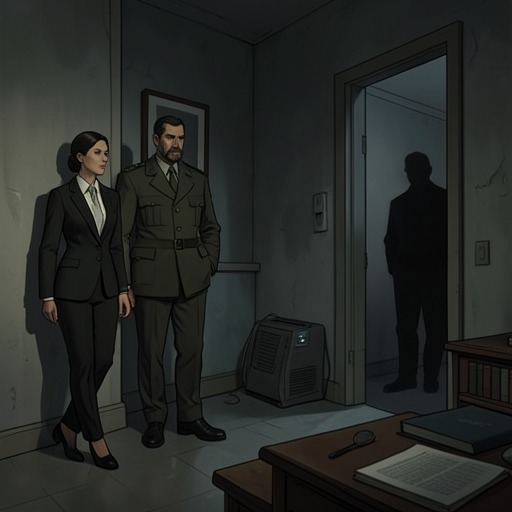
Military Intelligence (South Africa)
Heart of the HunterMilitary Intelligence (South Africa) is one of the three established arms of South Africa’s intelligence community, alongside the National Intelligence Agency and South Africa’s Secret Service. In the novel, its significance lies less in a clearly delineated operation than in its place within a fractured post-apartheid system: its records and institutional interests form part of the struggle to consolidate intelligence work, while suspicion among agencies repeatedly complicates efforts to establish who controls information and why.
Position in the Intelligence Community
A later intelligence assessment describes the Presidential Intelligence Agency as an effort to counter the continuing infighting, jealousy, and political competition among the National Intelligence Agency, South Africa’s Secret Service, and Military Intelligence (South Africa). The PIA was created in 2000, and its staff were drawn from outside the intelligence community apart from its Director. This arrangement marks Military Intelligence (South Africa) as part of the older institutional landscape the new agency was intended to work around, rather than as the body that replaced it.
The novel connects that institutional rivalry to the unsettled work of building a unified intelligence service after the elections. The inherited system contained multiple branches, and officials concealed information, lied, and competed with one another. Consolidation was therefore not simply a matter of combining offices: it required dividing work into projects and compartmentalizing it, even as the agencies remained entangled through their records and competing claims to information.
Records and the Work of Integration
Military Intelligence (South Africa) appears among the sources of the vast collection of computer records gathered for a central database project. The project also encompassed material from Infoplan in Pretoria, Denel, the Security Police, South Africa’s Secret Service, and ANC systems in Lusaka and London. The estimated volume was four or five hundred gigabytes, ranging from public information to weapons systems, informants, and double agents. A former intelligence worker was tasked with combining the records, removing material that could cause trouble, preserving useful information, and creating a uniform platform.
That work gives the organization a place in the novel’s broader concern with how intelligence archives are made and controlled. The records were not neutral stores of facts: their selection, survival, and deletion could affect what the state knew and what it could later prove. Accounts of operational records disappearing during the integration process show that some personnel could not accept the new system of accountability. Johnny Kleintjes began making backup copies when he realized records were being deleted, and eventually took work home after one of the backup tapes disappeared. The account does not identify Military Intelligence (South Africa) as the source of those deletions; rather, it locates the problem in the wider intelligence environment in which its files were being consolidated.
Rivalry, Suspicion, and Operational Friction
When Janina Mentz tries to understand who may have taken the CIA out of the Lusaka operation, she considers several competing explanations: the National Intelligence Agency, South Africa’s Secret Service, or Military Intelligence (South Africa). The hard disk’s contents, she reasons, might help identify the responsible party. Military Intelligence (South Africa) is thus one possibility in an unresolved inquiry, not a confirmed participant in the killings or the seizure of intelligence. The uncertainty reflects the novel’s portrait of agencies whose rivalry makes even basic attribution difficult.
The same lack of coordination surfaces during the manhunt for Thobela Mpayipheli. Tiger Mazibuko complains that provincial commands want to control the operation, that roadblocks lack enough radios, and that Groblershoop is uncovered because trucks have broken down. These failures illustrate the practical cost of institutional and command-level friction. The scene does not assign those specific failures to Military Intelligence (South Africa), but it echoes the broader organizational disorder against which the agency is positioned.
Place in the Novel’s Institutional Critique
Senior intelligence and security officials eventually meet with the Minister of Intelligence as the crisis surrounding Mpayipheli, a missing hard disk, and an abducted woman and child draws public and political scrutiny. The meeting brings together heads of the National Intelligence Agency, South Africa’s Secret Service, Presidential Intelligence, Defence, and Police. Military Intelligence (South Africa) is not specifically named as an attendee in this account, but the gathering conveys the interagency scale of the crisis and the political pressure placed on the intelligence system as a whole.
The organization’s narrative role is consequently structural rather than that of a fully individualized actor. It belongs to the inherited intelligence apparatus whose records must be merged, whose institutional rivalries inform the creation of the PIA, and whose possible involvement remains among the explanations Mentz cannot yet confirm. That distinction matters: the novel presents intelligence power as dispersed across agencies, archives, and chains of command, so that the presence of Military Intelligence (South Africa) in the system does not by itself resolve who acted, who concealed information, or what the hard disk contains.